Botox Treatments Natural-Looking Results You'll Actually Love
What Is Botox?
How Botox Works
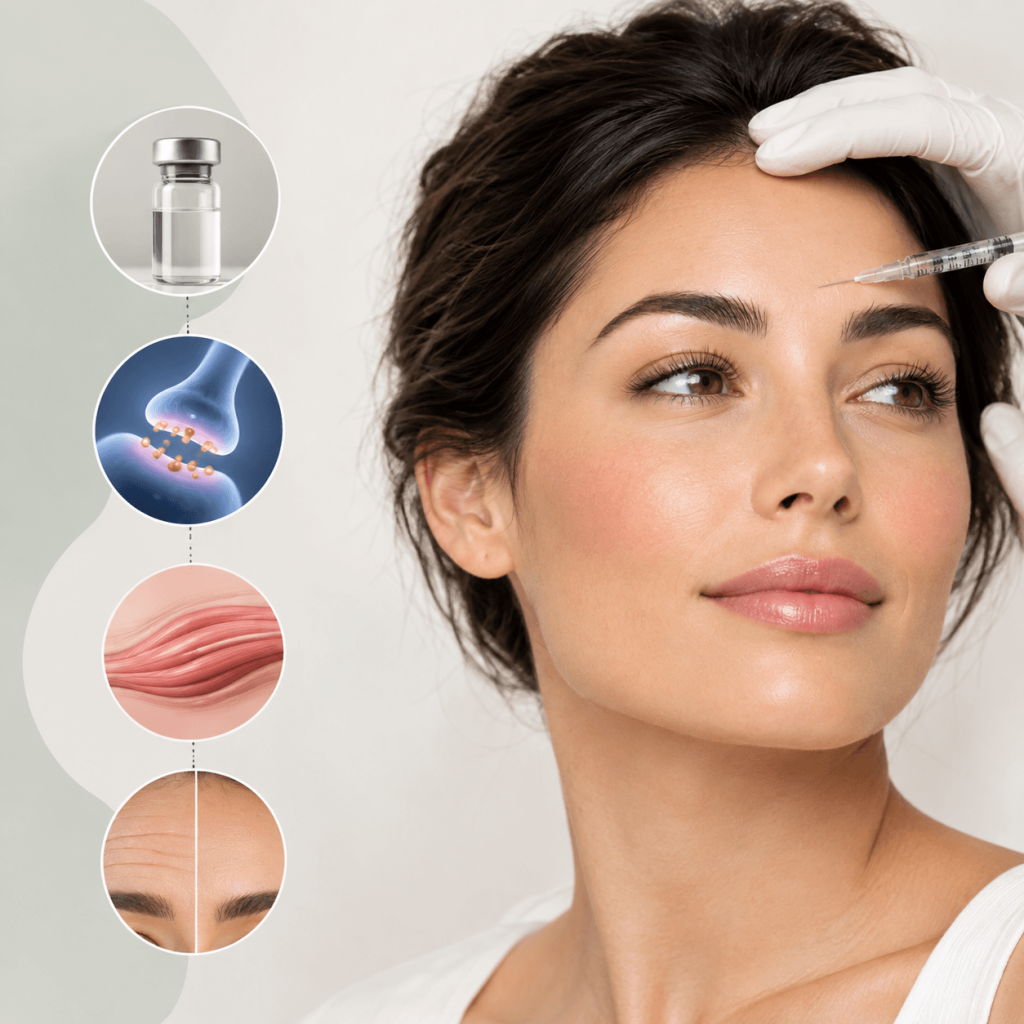
Your facial muscles contract through a chemical process: nerve endings release a neurotransmitter called acetylcholine, which travels across the gap between the nerve and the muscle and triggers the muscle to contract. This is how every voluntary muscle movement in the body works — including the expressions your face makes hundreds of times each day.
Step 1
Facial muscle contracts during expression
Step 2
Botox injected precisely into target muscle
Step 3
Acetylcholine release temporarily blocked
Step 4
Muscle relaxes, overlying skin smooths
Botox vs Dermal Fillers What Is the Difference?
- Relaxes muscles temporarily
- Addresses dynamic expression lines
- Forehead, frown lines, crow’s feet, and more
- Results last approximately 3 to 4 months on average
- No volume added
- Restores and adds volume
- Addresses static wrinkles and volume loss
- Lips, cheeks, under-eyes, nasolabial folds, and more
- Results last 6 to 18 months depending on product and area
- Structural change to the face’s volume
Benefits of Botox Treatment
Softens Dynamic Expression Lines
Forehead lines, frown lines, and crow’s feet can be significantly softened with well-placed Botox, reducing their visibility at expression and, over time, at rest.
Refreshed Appearance With No Downtime
Most clients return to their normal daily activities immediately after treatment. There is no recovery period or visible evidence of treatment for most clients.
Natural-Looking Results When Done Well
Botox applied with the right dosage and precise placement produces results that look relaxed and refreshed, not frozen or noticeably "done."
Preventive as Well as Corrective
Using Botox before deep lines become set in the skin helps prevent the more pronounced lines that develop with years of uninterrupted expression.
Addresses Multiple Concerns in One Appointment
Forehead, brow, eyes, jaw, neck. Multiple areas can be treated in a single appointment, making Botox one of the most time-efficient aesthetic treatments available.
Reversible and Temporary
Botox gradually wears off as the body’s natural nerve regeneration restores muscle function. This makes it a lower-commitment starting point for clients new to aesthetic treatments.
Treatment Areas
What it is
Horizontal lines across the forehead are caused by the frontalis muscle, which contracts each time you raise your eyebrows. Repeated over years, these contractions create visible creases in the overlying skin.
What the treatment does
Botox injected into the frontalis muscle reduces its activity, allowing the horizontal lines to soften. Our team assesses brow position and muscle anatomy before treating this area to avoid unwanted heaviness or lowering of the brow.
What it is
The "11 lines" between the eyebrows appear when frowning, concentrating, or squinting, caused by the corrugator supercilii and procerus muscles. When visible at rest, many clients describe looking permanently cross or tense.
What the treatment does
Botox was first approved for glabellar frown lines, making this the most evidence-backed area of cosmetic Botox use. Injection relaxes the frown pattern, softening the vertical lines progressively.
What it is
Lines that fan outward from the outer corners of the eyes during smiling or squinting, caused by the orbicularis oculi muscle. This skin is among the thinnest on the face.
What the treatment does
Botox injected precisely into the lateral orbicularis oculi softens the fanning lines without affecting the central or lower portions of the eye ring muscle responsible for blinking.
What it is
A chemical brow lift uses small, precisely placed amounts of Botox to achieve a subtle upward shift in brow position without surgery.
What the treatment does
As muscles that depress the brow are relaxed, elevator muscles gain a relative advantage, producing a subtle lift that opens the eye area. A nuanced technique working within a small margin for natural improvement.
What it is
Diagonal or horizontal lines on the bridge and sides of the nose when scrunching, created by contraction of the nasalis muscle. Often included alongside forehead and glabellar treatment.
What the treatment does
Small amounts of Botox injected into the nasalis muscle smooth the bunny lines without affecting normal nasal function.
What it is
Fine vertical lines around the mouth from repeated pursing. A lip flip uses a small amount of Botox in the upper orbicularis oris to roll the upper lip subtly outward, without adding volume.
What the treatment does
For perioral lines, Botox reduces pursing contractions. For the lip flip, a precise conservative amount produces subtle eversion. Both require careful, conservative dosing in this sensitive area.
What it is
An "orange peel" or "cobblestone" texture on the chin caused by chronic hyperactivity of the mentalis muscle.
What the treatment does
Botox injected into the mentalis muscle smooths the chin surface and reduces dimpling, producing a smoother, more even chin contour.
What it is
The masseter is the powerful chewing muscle on each side of the jaw. An enlarged masseter, from genetics or clenching/grinding, creates a wide, square lower face and can cause jaw tension.
What the treatment does
Botox injected into the masseter causes it to gradually reduce in size, tapering the lower face over weeks to months. Can also provide functional relief from grinding and jaw tension.
What it is
The platysma muscle can become more prominent with age, creating visible vertical neck bands and pulling down on the jawline.
What the treatment does
The Nefertiti lift uses Botox along the jawline and platysma bands to reduce downward pull, improving jawline definition and smoothing neck bands. Best for mild to moderate banding.
Who Is Botox Suitable For?
- Adults with visible dynamic expression lines in the forehead, between the brows, around the eyes, or elsewhere on the face
- Clients in their mid-20s or older who want to address early line formation proactively
- Clients with masseter enlargement causing facial width they would like to reduce, with or without associated jaw tension
- Clients with visible platysmal neck bands seeking a non-surgical improvement in neck and jawline appearance
- Clients with realistic expectations about natural-looking, temporary results
- Anyone currently pregnant or breastfeeding
- Clients with a known allergy to botulinum toxin or to any ingredient in the formulation
- Clients with certain neuromuscular conditions such as myasthenia gravis, Lambert-Eaton syndrome, or ALS
- Clients with an active skin infection or inflammatory skin condition at the planned injection site
- Clients on blood-thinning medications or anticoagulants should disclose these fully at consultation, as timing and dosing adjustments may be appropriate.
What Happens During Your Botox Appointment
Before and After Your Treatment
- Avoid alcohol for 24 to 48 hours before treatment, as it increases the likelihood of bruising.
- Avoid aspirin, ibuprofen, and other NSAIDs for 5 to 7 days before treatment where medically safe (check with your physician before stopping any regular medication).
- Avoid fish oil, high-dose vitamin E, and other blood-thinning supplements in the days before treatment.
- Arrive with clean skin, free of makeup, moisturisers, and sunscreen in the treatment areas.
- Inform your specialist of any recent skin treatments, injections, or changes in health or medications.
- Do not rub, press, or massage the treated areas for 24 hours after your appointment.
- Remain upright for at least 4 hours after treatment. Avoid lying flat or bending forward significantly.
- Avoid vigorous exercise for 24 hours after treatment.
- Avoid heat exposure, including saunas, steam rooms, and hot baths, for 24 to 48 hours.
- Avoid facial massages and facial treatments for at least 2 weeks.
- Apply sunscreen to any exposed treated areas when going outside.
- Do not expect immediate results. Initial softening begins within 3 to 5 days, with full result at 10 to 14 days.
Results and Timeline
When will I see results?
Initial softening usually becomes noticeable within 3 to 5 days. The full effect takes up to 10 to 14 days to develop. Assess your final result no earlier than the two-week point.
How long do results last?
For most clients and areas, results last approximately 3 to 4 months on average, with significant individual variation based on metabolism, muscle strength, and dosage.
Will results look natural?
When applied with the right dosage and placement for your anatomy, the result should look like a rested, refreshed version of you. Expression and natural movement remain intact.
Does Botox prevent future wrinkles?
For clients who begin before lines become set at rest, regular treatment can help maintain smoother skin over time by reducing the depth of contractions that deepen dynamic lines.
Safety, Side Effects, and What to Know
- Mild bruising, swelling, or redness at the injection points, typically resolving within a few days.
- Tenderness or mild soreness at the injection site, usually resolving within 24 to 48 hours.
- A mild headache in the hours following forehead treatment, typically resolving the same day.
- Temporary asymmetry between sides that typically resolves as the treatment settles. A 2-week review allows for assessment and adjustment.
- Brow heaviness or eyelid ptosis, a rare occurrence from migration, resolving within 2 to 6 weeks.
- Difficulty with some lip movements or sounds, which can occur with lip area treatment if dosing is not conservative.
Do Not Proceed With Botox If You Are
- Pregnant or breastfeeding
- Diagnosed with myasthenia gravis, Lambert-Eaton syndrome, ALS, or other neuromuscular conditions
- Allergic to botulinum toxin or to albumin
- Experiencing an active skin infection at the planned injection site
Why Choose DermEsthetics for Your Botox Treatment
Individual Assessment, Every Time
We assess your facial anatomy, muscle activity, and existing lines before making any recommendation. The plan for your face is built around your face, not a standard chart.
Conservative Dosing With Natural Results
We prioritize results that move with your face and reflect your expressions naturally. Our approach is always to start conservatively and adjust rather than to over-treat.
A 2-Week Review as Standard
Our team schedules a review appointment at 2 weeks to assess your result. If a small adjustment is appropriate, we discuss it then. Aftercare does not end when you walk out the door.