
Physician-Led Vascular Laser Treatment

Spider Vein and Thread Vein Treatment in Mississauga

Clinically proven laser treatment for spider veins, broken capillaries, cherry angiomas, and other superficial vascular lesions. Every treatment begins with a thorough assessment to ensure the most effective approach and realistic results for your skin.
The Science of Beauty

Understanding Spider Veins and Visible Vascular Lesions
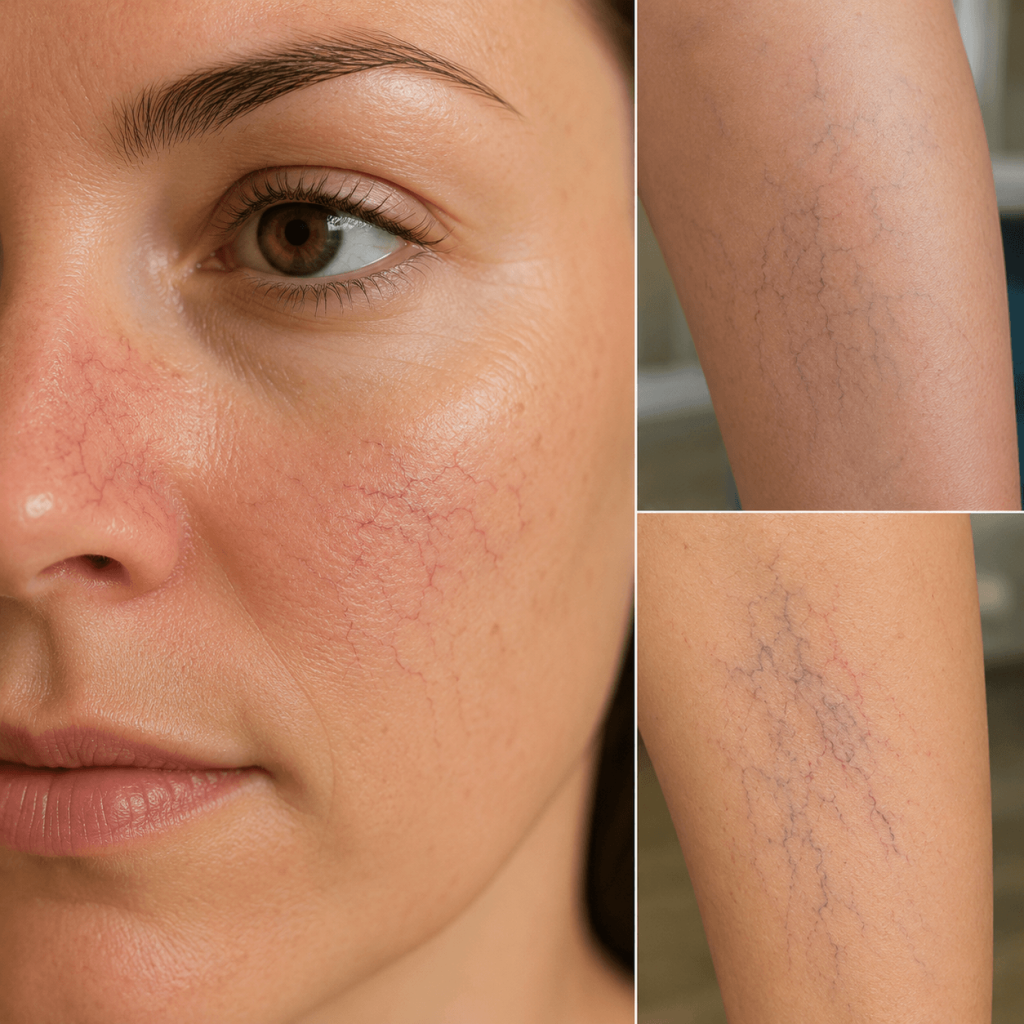
Spider veins medically known as telangiectasia are small, permanently dilated blood vessels that have become visible near the surface of the skin. They appear as fine red, blue, or purple lines, often in web-like or branching patterns, and typically range in size from a fraction of a millimetre to a few millimetres in diameter. They are most commonly found on the face (particularly the nose and cheeks) and on the legs.
Spider veins form when small blood vessels lose their ability to contract and remain in a state of permanent dilation. They are almost always a cosmetic concern rather than a medical one — typically painless and not structurally risky in themselves. However, their visibility on the skin’s surface can be significant, and for many clients they become progressively more noticeable over time without treatment.
What spider veins are not is equally important. They are not the same as varicose veins, which are larger, often bulging, and can involve deeper structural problems with venous valves that may require medical management. Understanding this distinction matters when choosing the right treatment path — and our team will always help you navigate it clearly.
“Spider veins are one of the most common cosmetic concerns we see. They are also one of the most successfully treated with the right technology and the right approach.”
Sadia Tarar Aesthetic Expert
The Causes

What Causes Spider Veins to Form?

Spider veins rarely have a single cause. Several factors can contribute to their development, and understanding yours helps our team recommend the most appropriate treatment plan.
01
Genetics
A family history of spider veins is one of the strongest predictors of developing them. Genetic predisposition affects the structural integrity of vein walls and valves, making some people more prone to vessel dilation than others.
02
Hormonal Changes
Pregnancy, oral contraceptives, and hormonal shifts during perimenopause can all weaken vein walls and increase susceptibility to vessel dilation. Many clients notice spider veins became more prominent or appeared for the first time during or after pregnancy.
03
Prolonged Standing or Sitting
Long periods of standing or sitting increase pressure on leg veins and reduce efficient blood return. Over time, this sustained pressure can cause small vessels to dilate and remain visible — common in standing-intensive professions.
04
Sun Exposure
Cumulative UV exposure weakens the connective tissue that supports small blood vessel walls, particularly on the face. Over years of sun damage, vessels lose structural support and dilate. Facial spider veins on the nose and cheeks are frequently the result of long-term UV exposure.
05
Age
As the skin naturally thins and loses collagen with age, existing blood vessels become more visible and new dilated vessels more easily apparent. Spider veins tend to become more prominent from the mid-30s onward and typically increase with each decade.
06
Physical Trauma or Skin Injury
Broken capillaries can develop from localised trauma — including impact injury, aggressive facial massage, or forceful nose-blowing. The tiny capillaries on the face are particularly vulnerable to mechanical pressure.
Know the Difference

Spider Veins vs Varicose Veins Why the Distinction Matters

Spider veins and varicose veins are both visible vascular conditions sharing some risk factors — but they are clinically distinct, they behave differently, and they require different treatment approaches.
Spider veins are small (typically under one millimetre in diameter), superficial, and sit very close to the skin’s surface. They are almost always a cosmetic concern, rarely cause symptoms, and respond well to non-invasive laser treatment.
Varicose veins are significantly larger, often three millimetres in diameter or more. They frequently bulge visibly above the skin’s surface and can be associated with symptoms including aching, heaviness, cramping, and swelling in the legs. In many cases they reflect an underlying problem with the venous valves — a structural issue requiring medical assessment and may need treatments such as sclerotherapy, endovenous laser therapy, or surgical intervention. Cosmetic laser treatment of the surface vessels is not appropriate here.
At DermEsthetics, our vascular laser treatment is appropriate for superficial spider veins, thread veins, broken capillaries, and small vascular lesions — not for large varicose veins or underlying venous insufficiency. Our team will assess your vascular presentation at consultation. If we identify features suggesting an underlying venous problem, we will tell you directly and recommend the appropriate next step.
An Important Note
If you have varicose veins accompanied by leg pain, heaviness, swelling, or cramping — or if your spider veins have appeared suddenly in large numbers — we recommend a medical assessment before any cosmetic treatment. Our team will help direct you to the right resources.
The Treatment

How Laser Treatment Targets Spider Veins

Laser treatment for spider veins works through selective photothermolysis. Laser energy is emitted at a wavelength preferentially absorbed by haemoglobin — the protein in red blood cells that serves as the target chromophore for vascular laser treatment.
When the laser pulse reaches the target vessel, haemoglobin within it absorbs the energy and converts it to heat. This heat causes the vessel wall to coagulate, collapsing the vessel without damaging the surrounding skin tissue. Over the days and weeks following treatment, the body naturally reabsorbs the coagulated vessel. The visible vein gradually fades as this process completes.
At DermEsthetics, our spider vein treatments are performed using the GentleMax Pro by Candela Medical, a dual-wavelength laser platform. For vascular concerns, our team primarily uses the 1064nm Nd:YAG wavelength. At this wavelength, the laser penetrates deep enough to reach and coagulate the target vessel while its comparatively lower absorption by surface epidermal melanin makes it safer across a broader range of skin tones — particularly important for leg spider veins, which sit deeper than fine facial vessels. Every treatment parameter — wavelength, pulse duration, spot size, and energy level — is calibrated to the specific vessel being treated and your individual skin profile. Integrated Dynamic Cooling Device technology delivers a protective cooling burst with every laser pulse.

Laser Calibrated

Wavelength, energy, and spot size are set precisely for your skin tone and the target vessel.

Haemoglobin Absorbs Energy

Laser energy is preferentially absorbed by haemoglobin inside the vessel, converting to heat.

Vessel Coagulates

The heated vessel coagulates and collapses. Surrounding skin tissue remains unaffected.

Body Naturally Reabsorbs

Over days and weeks, the body clears the treated vessel tissue and the visible vein fades.

Where We Treat

Vascular Concerns Our Team Treats

Our laser vascular treatments address six types of superficial vascular concern. Find the one that sounds most like yours.
Facial
Facial Spider Veins
Fine, dilated vessels on the nose, cheeks, and chin — ranging from generalised redness to distinct thread-like lines. Common in lighter skin tones; frequently linked to sun exposure, rosacea, or genetics.

How We Treat

Among the most reliably treated vascular concerns. Clinical studies report 95 to 100 percent clearance of facial telangiectasia, often after just 1 to 2 sessions.

Typical results: Clearance within 1 to 2 sessions
Spacing: 4 to 6 weeks
Legs
Leg Spider Veins
Fine, dilated vessels on the thighs, calves, and ankles often in web-like clusters. Common from middle age, frequently linked to genetics, pregnancy, and prolonged standing.

How We Treat

Respond well when vessels are small and superficial (under 3mm). Results are more variable than facial treatment. Our team sets expectations honestly at consultation.

Typical results: Progressive improvement over 2 to 5 sessions
Spacing: 6 to 8 weeks
Veins larger than 3 to 4mm, or accompanied by aching or swelling, should be assessed for venous insufficiency before laser treatment.
Face and Legs
Thread Veins (Telangiectasia)
Fine, persistently dilated vessels as single lines or branching networks on the face or legs. Common from the 30s onward. On the face: nose and cheeks. On the legs: thighs, calves, and ankles.

How We Treat

Respond well to targeted laser energy. Facial thread veins often show visible improvement within 1 to 2 weeks of a session as the body begins clearing the coagulated tissue.

Facial: 1 to 3 sessions. Legs: 2 to 5 sessions.
Spacing: 4 to 6 weeks (facial), 6 to 8 weeks (legs)
Face
Broken Capillaries
Tiny, permanently dilated capillaries appearing as small red dots or fine lines, most commonly on the nose, cheeks, and around the eyes. Permanently unable to contract — not truly “broken”.

How We Treat

Extremely responsive to laser. Our team calibrates spot size and energy level carefully, targeting each vessel individually where necessary for precise coagulation.

Typical results: Clearance within 1 to 2 sessions
Spacing: 4 to 6 weeks
Face and Body
Cherry Angiomas
Small, bright red domed spots caused by an overgrowth of blood vessels at the skin’s surface. Entirely benign and increasingly common from age 30 onward.

How We Treat

Respond very well to laser. Clinical studies report clearance rates approaching 100 percent with 1064nm Nd:YAG. Most clients need just 1 to 2 sessions.

Typical results: Clearance within 1 to 2 sessions
Spacing: 4 to 6 weeks
A sudden large increase in cherry angiomas can occasionally indicate underlying health changes. Our team will ask about this at consultation.
Face and Body
Small Superficial Vascular Lesions
Includes spider angiomas, small haemangiomas, and other minor vascular ectasias. Most are entirely benign and purely cosmetic concerns.

How We Treat

Approach varies by lesion type, size, and depth. Our team assesses each lesion at consultation and confirms whether laser is appropriate and what results are realistic.

Typical results: Clearance in 1 to 3 sessions
Spacing: 4 to 6 weeks
Any lesion that has recently changed appearance, bled unexpectedly, or is associated with other symptoms should be medically assessed before cosmetic treatment.
Why Laser Is the Right Choice

Benefits of Laser Spider Vein Treatment

Clinically Proven Results

Long-pulsed 1064nm Nd:YAG laser is one of the most evidence-backed approaches to superficial vascular lesions, with published studies reporting clearance rates of 80 to 100 percent across facial telangiectasia and spider angiomas.

No Downtime for Most Clients

Most clients return to their normal routine immediately after each session. Mild redness and temporary darkening of treated vessels in the first 24 to 72 hours settle naturally without restricted activity.

Targets the Vessel, Not the Surface

Laser energy reaches the haemoglobin inside the vessel rather than masking the lesion at the skin's surface. The result is a genuine structural change, not a temporary cosmetic effect.

Comfortable, With Integrated Cooling

Built-in Dynamic Cooling Device technology delivers a brief protective cooling burst before each laser pulse, keeping sessions comfortable and protecting the surrounding skin throughout.

Safe Across a Range of Skin Tones

The 1064nm Nd:YAG wavelength has lower surface melanin absorption than shorter vascular wavelengths, making it a safe and effective choice for a broader range of skin tones.

Honest, Evidence-Based Expectations

Our team tells you what results are realistic for your specific concern before you book. Facial veins and cherry angiomas respond very predictably. Leg spider veins are more variable and we will discuss this honestly rather than overpromise.

The DermEsthetics Difference

Why Choose DermEsthetics for Spider Vein Treatment

Vascular laser treatment is one of the areas where clinical expertise and technology selection matter most. The wrong wavelength, the wrong energy setting, or a missed assessment finding can result in skin damage, insufficient results, or — in the case of larger varicose veins — treating the wrong condition entirely. Choosing a clinic that assesses thoroughly and communicates honestly is not a preference. It is a clinical necessity.
At DermEsthetics, every spider vein and vascular laser treatment is performed by a trained, credentialed member of our medical aesthetics team, working to protocols developed under the clinical oversight of Dr. Sadia Tarar, MBBS, our founder and clinical director with over 25 years of combined medical and aesthetics experience. We assess every client’s vascular presentation before any treatment begins — and we will always tell you if a referral for medical assessment is the right first step.

Thorough Assessment First

We assess your vascular lesion type, size, depth, and medical history before recommending any treatment. If your concern warrants medical review rather than cosmetic treatment, we will tell you directly.

Precise Calibration at Every Session

Every treatment parameter is set specifically for your skin tone and the vessel being treated. We do not apply a single generic protocol precision is how we protect both your safety and your result.

Honest, Realistic Expectations

We distinguish clearly between what responds predictably (facial spider veins, cherry angiomas) and what is more variable (leg spider veins). You will always know what to expect before you begin.

What to Expect

Your Treatment Experience at DermEsthetics

Consultation

Thorough assessment of your vascular concern: type, size, depth, and distribution. We review medical history and skin tone, confirm laser is appropriate (particularly for leg veins), discuss realistic results and session numbers. No treatment proceeds until you are fully informed.

The Treatment

The treatment area is cleansed and the laser is calibrated to your skin and target vessel. Protective eyewear provided. Precise pulses with an integrated cooling burst before every one. Sessions typically 20 to 45 minutes depending on lesion type and distribution.

Immediately After

Treated area looks more red or flushed. Individual thread veins or spider veins may appear temporarily darker for 24 to 72 hours a normal, expected response. Cherry angioma sites may crust slightly before fading.

The Healing Process

Over 1 to 4 weeks following each session, treated vessels and lesions fade progressively. Facial vessels respond and clear more quickly than leg vessels. Your specialist confirms the appropriate timing for your follow-up session.

Aftercare

Daily SPF 30+ on any treated area exposed to daylight. Avoid heat-generating activities for 48 to 72 hours. Keep skincare gentle and fragrance-free in the treated area. Do not pick at any crusting on cherry angioma sites.

Realistic Expectations

Results and Timeline

Results vary by lesion type, size, depth, and location. We set expectations clearly at consultation so you understand what to expect before your first session.

Immediately After

Treated vessels appear temporarily more red or prominent for 24 to 72 hours. Cherry angioma sites may form a small crust. These responses settle naturally and indicate the laser has reached its target.

Weeks 1 to 4 After Each Session

Treated vessels begin to fade as the body reabsorbs coagulated tissue. Facial spider veins and cherry angiomas respond within the first 1 to 2 weeks. Leg spider veins take longer 3 to 6 weeks as the deeper vessels clear.

After a Full Course

Facial spider veins: most clients achieve significant clearance in 1 to 3 sessions. Cherry angiomas: typically clear in 1 to 2. Leg spider veins: significant improvement after 2 to 5 sessions, though results are more variable.

Ongoing Maintenance

Treated vessels do not return once fully reabsorbed. New vessels can develop over time if contributing factors remain present. Occasional maintenance sessions and consistent sun protection help sustain results.

Treated vessels do not return once they have been fully reabsorbed by the body. However, new vessels can develop if the underlying contributing factors — sun exposure, hormonal changes, prolonged standing — remain present. Our team will advise on realistic maintenance planning at consultation.
Is This Treatment Right for You?

Suitable Candidates for Laser Spider Vein Treatment

Laser spider vein treatment is appropriate for a wide range of clients with superficial vascular concerns, but suitability depends on the specific type, size, and location of the vessel or lesion. Your consultation will confirm what is right for you.
Well-Suited Candidates
This Treatment May Not Be Appropriate If You
The Details

Treatment Details

Concern Sessions
Facial Spider Veins and Broken Capillaries 1 to 3
Cherry Angiomas 1 to 2
Thread Veins (Face) 1 to 3
Thread Veins and Spider Veins (Legs) 2 to 5
Small Superficial Vascular Lesions 1 to 3

Session Details

Duration
20 to 45 minutes for most clients. Individual cherry angiomas or a small cluster may take considerably less.
Spacing (Facial)
4 to 6 weeks between sessions
Spacing (Legs)
6 to 8 weeks to allow treated vessels to fully clear before retreating
During Treatment
Brief warm snapping sensation per pulse, kept comfortable by integrated cooling. Mild flushing settling within hours.

Before Your Appointment

After Your Treatment

Questions Answered

Frequently Asked Questions

What is the difference between spider veins and varicose veins?
Spider veins are small, superficial, thread-like vessels visible near the skin’s surface — typically under 1mm in diameter and almost always a cosmetic concern. Varicose veins are significantly larger, often 3mm or more in diameter, and can bulge visibly above the skin. They frequently reflect an underlying problem with venous valve function that may require medical management. Laser cosmetic treatment is appropriate for spider veins but not for varicose veins or underlying venous insufficiency. If you are unsure which you have, our team will assess this at consultation.
It depends on the type and extent of your vascular concern. Facial spider veins often achieve significant clearance in 1 to 3 sessions. Cherry angiomas typically clear in 1 to 2 sessions. Leg spider veins are more variable and may require 2 to 5 sessions. Your specialist will give you a personalised recommendation at consultation.
We use the GentleMax Pro by Candela Medical, a dual-wavelength laser platform. For vascular concerns, our team primarily uses the 1064nm Nd:YAG wavelength, which penetrates to the depth of the target vessel and has lower surface melanin absorption than shorter-wavelength alternatives — making it both effective and safer across a broader range of skin tones.
Briefly, yes — and this is entirely expected. In the 24 to 72 hours following treatment, treated vessels typically appear temporarily darker or more prominent as the coagulation response takes effect. This is a sign the treatment has worked as intended. The darkening settles and the vessels begin to fade progressively over the following weeks.
Yes. Most clients describe each laser pulse as a brief, warm snapping sensation, kept comfortable by built-in Dynamic Cooling Device technology that delivers a protective cooling burst before every pulse. Most clients do not require topical anaesthetic for facial vein treatment. For leg vein treatment, some clients find the sensation slightly more intense in certain areas — your specialist will adjust settings accordingly.
No significant downtime for most clients. Mild redness, temporary flushing, and darkening of treated vessels in the first 24 to 72 hours are normal but do not prevent daily activity for most people. We recommend avoiding heat, strenuous exercise, and direct sun exposure for 48 to 72 hours after each session.
Facial spider veins respond more predictably and consistently than leg spider veins. Clinical studies report 95 to 100 percent clearance for facial telangiectasia vs. approximately 80 percent for leg veins over a course of sessions. Leg veins are subject to ongoing circulatory pressure and typically sit deeper, making results more variable. Our team will always discuss this difference honestly at consultation, rather than applying the same expectation to both areas.
Cherry angiomas are small, benign red domed spots caused by an overgrowth of blood vessels at the skin’s surface. They are harmless and extremely common in adults over 30. Laser treatment achieves very high clearance rates for cherry angiomas — clinical studies with 1064nm Nd:YAG laser have reported clearance approaching 100 percent. Most clients need just 1 to 2 sessions.
The 1064nm Nd:YAG wavelength we use for vascular treatment has comparatively lower absorption by surface epidermal melanin than shorter-wavelength vascular lasers, making it safer for a broader range of skin tones. Your Fitzpatrick skin type will be assessed at consultation and your specialist will calibrate settings appropriately.
Treated vessels do not return once they have been fully reabsorbed by the body. However, new vessels can develop over time if the contributing factors remain present — particularly sun exposure, hormonal changes, and prolonged standing for leg veins. Consistent sun protection, lifestyle awareness, and occasional maintenance sessions where needed help sustain results long term.
If you have both spider veins and varicose veins on your legs, the varicose veins should be assessed medically first to rule out underlying venous insufficiency. Treating spider veins with laser when there is significant underlying venous pressure from poorly functioning valves is unlikely to achieve lasting results. Our team will assess this and refer you for medical review if needed.
Most spider veins are purely cosmetic and carry no medical risk. However, a medical review is warranted if: you experience pain, swelling, or heaviness alongside your leg veins; you notice a sudden, large increase in the number of cherry angiomas or spider angiomas; or your spider veins are accompanied by other skin or systemic symptoms. Our team will ask about these factors at consultation.
Avoid sun exposure and tanning for at least 4 weeks. Avoid retinoids and active skincare in the treatment area for 48 hours. Arrive with clean skin, no makeup or moisturisers on the treatment area. For leg vein treatment, wear loose clothing. Avoid alcohol and vasodilators in the 24 hours before. Disclose all medications at consultation.
Protect the treated area from sun exposure and apply SPF 30 or higher consistently. Avoid heat and strenuous exercise for 48 to 72 hours. Keep skincare gentle. For cherry angioma sites, allow any small crusting to resolve naturally without interference. For leg vein treatment, consider wearing compression hosiery in the days following each session.
Book a complimentary consultation through the button on this page, by phone, or by reaching out via WhatsApp or Instagram. Our team will assess your vascular concern, explain what is appropriate for your specific presentation, and build a realistic treatment plan for you.
Client Love

What Our Clients Say

Clear, Confident Skin Starts with One Conversation.

Whether you have spider veins on your face or legs, broken capillaries, thread veins, or cherry angiomas, our team will assess your concern honestly and build a treatment plan tailored to you. Book your complimentary consultation today.